
If the interest rate on bank deposits is linked to any external benchmark, it would jeopardise the banks' fund-raising ability. Interest rates on small savings schemes are likely to be reduced very shortly, to maintain parity. All these steps would indeed affect retired people, and particularly those dependent on interest income, says Arindam Gupta.

These stocks offer the best combination of maximum 'buy' recommendations from brokerages and share price upside over the next 12 months.

The Reserve Bank of India on Thursday kept the benchmark interest rate unchanged at 4 per cent and decided to continue with its accommodative stance against the backdrop of an elevated level of inflation.

Since March 31, 2022, the PSBs' market cap has risen 43.7 per cent, from Rs. 7.29 trillion to Rs. 10.47 trillion. It's time for the government, the majority owner of public sector banks, to reap the benefit of the rally in bank stocks, recommends Tamal Bandyopadhyay.

Stock market investors are expecting a balanced Budget with a focus on job creation, increased spending on infrastructure, reigning in the deficit, and bringing the economy back on track, experts said on Wednesday. Stock markets have been subdued in the run-up to the Union Budget with BSE's benchmark Sensex is almost flat so far this month. Even the corporate earning season failed to excite the markets, while some indices like IT and bankex have seen some positive movements.

Equity benchmark Sensex surged over 1,300 points on Monday to reclaim the 60,000-level, boosted by intense buying in banking and financial stocks after the announcement of merger between HDFC and HDFC Bank. Strong global cues and receding crude oil prices also propped up the domestic equity markets, according to traders. Shares of HDFC and HDFC Bank rallied nearly 10 per cent as investors lapped up the merger deal.

Financials declined amid profit taking while energy shares fell after the government hiked excise duty on transport fuels.

There are about 600,000 taxis in India, generating combined annual revenue of about Rs 11,000 crore (Rs 110 billion).

'Recent underperformance notwithstanding, equities should constitute a major part of investors' financial portfolio.'

'If the new rate is lower than your current rate, ask your bank to shift you to it.' 'This can be done by paying a fee of Rs 5,000 to Rs 6,000.'

India Inc on Friday said it is looking forward to a repo rate cut in future as cost of funds has to come down in coming times, and expects continuation of accommodative policy stance by the Reserve Bank of India (RBI). The RBI decided to leave the benchmark interest rate unchanged at 4 per cent but maintained an accommodative stance, as the economy faces the brunt of the second COVID-19 wave. Sanjay Aggarwal, president of PHD Chamber of Commerce and Industry, said the RBI has maintained an accommodative stance as long as necessary to revive and sustain growth on a durable basis and to mitigate impact of COVID-19, apart from an aim to keep inflation within the target.

'Banks will continue to increase FD rates to attract more deposits and meet the increasing demand for credit.'

'The Indian economy and the Indian financial sector today remain resilient and much better placed.'

Banks looking to raise capital via bond sales to fund decade-high credit growth were compelled to put some of these debt issuances on hold amid a sharp rise in yields since late September, sources told Business Standard. A major private lender, Axis Bank, has not yet followed through with a planned issuance of infrastructure bonds worth around Rs 3,000 crore. This is because volatility in the bond market in late September led to investors seeking higher yields, sources said.
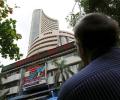
Financials were the top losers after sharp gains in the previous session along with ITC

Reserve Bank of India (RBI) on Friday kept the benchmark interest rate unchanged at 4 per cent and decided to continue with its accommodative stance despite rising inflation. This is the 11th time in a row that the Monetary Policy Committee (MPC) headed by RBI Governor Shaktikanta Das has maintained the status quo. RBI had last revised its policy repo rate or the short-term lending rate on May 22, 2020 in an off-policy cycle to perk up demand by cutting the interest rate to a historic low.

State Bank of India's earnings growth may turn lacklustre in the near-term, warn analysts. This, they said, could be due to margin compression and likely lower fee income over the next one year. "While the cost of deposits is repricing sharply across the system, there will be relatively lower yield expansion going ahead as most of the back-book has been repriced and there is a high competitive pressure on yields.

Financial numbers can sometimes paint a rosy picture because of changes in the accounting policy or a one-time income.
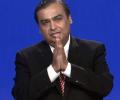
Reliance Industries Ltd, the nation's most valuable company, on Thursday said it has raised $4 billion (around Rs 30,000 crore) in debt through the largest ever foreign currency bond issuance by an Indian entity. The oil-to-telecom conglomerate plans to use the proceeds of the three tranche issues to retire existing borrowings. The issue was "nearly 3 times oversubscribed with a peak order book aggregating around $11.5 billion," the company said in a statement. This is the largest ever foreign currency bond transaction in India, eclipsing ONGC Videsh Ltd's $2.2 billion US dollar bonds issue of 2014.

'Government shouldn't be in the business of running airlines, instead it should develop the ecosystem of civil aviation.'

'We are most bullish on all aspects of the financial sector -- private sector banks, even one state-owned bank, insurance, mortgage finance, broking, wealth management, gold finance, etc.'
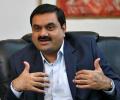
Adani Enterprises, which is launching India Inc's second-largest follow-on public offer worth Rs 20,000 crore next week, on Thursday said it is planning to enter the water segment as this is a key element of its core business of infrastructure. The group is into the entire gamut of infrastructure -- being its ports, airports, roads, expressways power generation & distribution, among others. In ports and airports, the group is the largest player in the private sector. Addressing media from Milan, group chief financial officer Jugeshinder Singh said the company has fixed the price band for the Rs 20,000-crore issue in the range of Rs 3,112-3,276 per share.

Finance minister Nirmala Sitharaman on Wednesday exuded confidence that inflation would further decline and the government is on track to meet its budgetary target for deficit and said that there is no fear of stagflation in India. Replying to the debate on first batch of Supplementary Demands for Grants 2022-23 in Lok Sabha, the finance minister said inflation has come down and it is now in the tolerable band of the RBI. Inflation has been declining since April 2022 and it is declining further, she said.

M&M was the top loser in the Sensex pack, shedding around 3 per cent, followed by Tata Steel, Bajaj Finserv, TCS, HDFC and Infosys. NSE Nifty declined 55.95 points to 17,076.25.
HDFC Bank Q4 review: HDFC Bank's January-March quarter (Q4) results, for financial year 2022-23 (FY23), brought no cheer to investors as elevated costs, and merger-related uncertainties continue to dent the sentiment. Moreover, analysts fear that merger-related costs may put pressure on margins and cost to income ratio in the near-term, while the return on equity could moderate owing to low leverage of the parent. Analysts, therefore, opine that the stock's re-rating may be some time away. "While the risk of a de-rating on a standalone basis appears to be quite low given that the business performance is holding up well, we believe a re-rating in the stock would happen as and when more clarity emerges on the smooth transition (merger)," said a report by Sharekhan.

Other gainers included Nestle India, Asian Paints, Bajaj Finance, NTPC, L&T, Axis Bank and Bajaj Auto. On the other hand, TCS, ONGC, Infosys, HDFC and SBI were among the laggards. NSE Nifty surged 121.65 points or 1.03 per cent to 11,889.40.

The number of draft red herring prospectuses (DRHPs) filed with the markets regulator - Securities and Exchange Board of India (Sebi) - jumped nearly fivefold to 145 in 2021-22 (FY22), compared with just 30 in the preceding financial year (2020-21, or FY21). This was on account of companies rushing to take advantage of a favourable market sentiment towards initial public offerings (IPOs), triggered by an influx of new investors, surge in the secondary market, and encouraging performance of newly listed stocks. In fact, DRHPs filed in FY22 was 4x the previous 10-year average and the highest since 2007-08, according to primary market tracker PRIME Database.

Most of the long-only funds are closed-ended. This means that investors have to lock in their money for a fixed period before they can take it back.

Kotak Bank was the top loser in the Sensex pack, shedding over 2 per cent, followed by ICICI Bank, PowerGrid, HDFC, IndusInd Bank and Axis Bank. NSE Nifty declined 45.75 points to 16,568.85.

Accelerating quantity and quality of entrepreneurship towards benchmarks from high-performing countries and Indian states can create over 30 million women-owned enterprises, of which 12 million can generate employment, a joint report by Bain & Company and Google said.

Bajaj Finserv was the top gainer in the Sensex pack, soaring around 8 per cent, followed by Tata Steel, Tech Mahindra, Bajaj Finance, HDFC Bank and SBI.

On the Sensex chart, Bajaj Finance, Bajaj Finserv, HCL Tech, Tech Mahindra, Infosys, HDFC Bank and ICICI Bank were among the prominent gainers.

Nivedita Mookerji explains why a timely rollout of 5G may not be easy in India.

For large start-ups the US market is considered to be a preferred destination, as Indian investors were seen as hesitant to pay the kind of valuation private equity investors or the US markets pay. However, Zomato's listing has quashed these notions.

Equity benchmarks Sensex and Nifty ended marginally lower on Tuesday as investors booked profits at higher levels amid a mixed trend in global markets.

PowerGrid was the top gainer in the Sensex pack, rallying over 4 per cent, followed by NTPC, UltraTech Cement, Tech Mahindra, Reliance Industries and IndusInd Bank.

Recent rates cuts by most banks may not have a significant impact on margins, say analysts.

Experts say companies wanting to launch IPOs will have to scale back their expectations given the fall in valuations.

Bajaj Finance was the top laggard in the Sensex pack, tanking up to 8 per cent, followed by M&M, Tata Steel, Bajaj Auto, ONGC, HDFC Bank and Kotak Bank. On the other hand, TCS, Tech Mahindra, HUL, Axis Bank and ITC were the top gainers.

Will private firms really boost Make in India in the defence sector? Ajai Shukla seeks answers.
 © 2026 Rediff.com - Advertise with us - Disclaimer - Privacy Policy - Sitemap - Feedback - About us - Terms of use - Grievances